Release time:Oct 07,2026
Click amount:'364
By:Guangdong Richeng Technology Industry Co., Ltd
If you’ve shortlisted and compared dozens of laundry detergent suppliers in China, you’ve likely run into the same frustrating problem: nearly every factory looks identical online. They post the same ISO certificates, similar production line photos, and identical quality guarantee promises. For global importers, supermarket procurement managers, and private label brand owners, this surface-level similarity makes it extremely difficult to screen which manufacturers can deliver stable batch quality, compliant export documents, and reliable long-term OEM support.
Many new buyers focus solely on unit price during initial negotiations, only to face severe post-cooperation losses including inconsistent product scent, unstable cleaning performance, delayed shipments, and failed customs clearance. After 22 years of serving global detergent importers, we’ve witnessed countless cooperation failures caused by superficial supplier screening rather than poor product quality. This practical, experience-driven B2B sourcing guide breaks down every core evaluation standard for China laundry detergent manufacturers, helping you eliminate unqualified suppliers and build low-risk, long-term manufacturing partnerships suitable for your regional market.
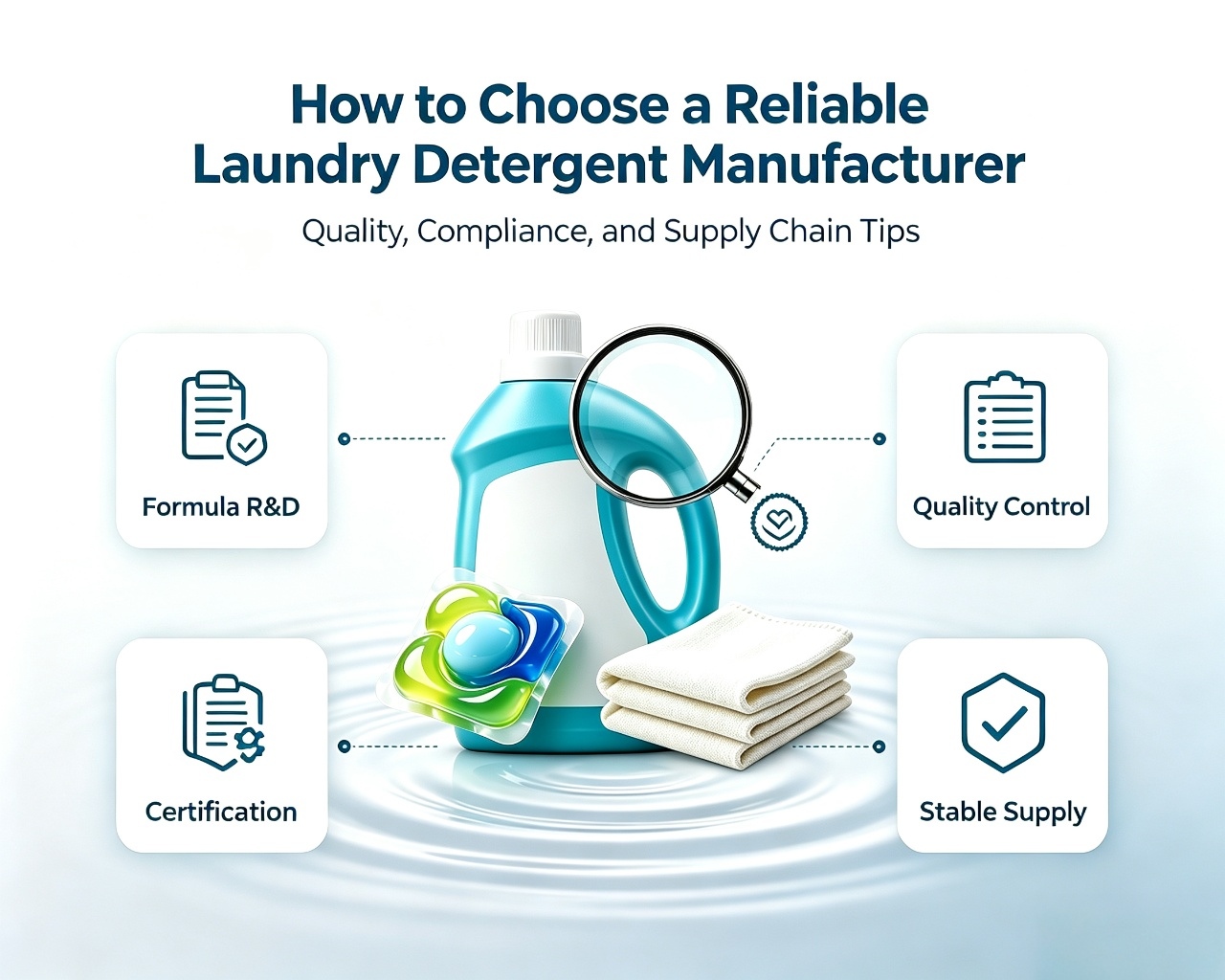
What Certifications Should a China Detergent Factory Hold for Export?
Before shortlisting any Chinese detergent supplier, your first priority is verifying complete legal and export certification documents. Many unlicensed workshops and pure trading companies lack standardized qualification systems, resulting in detergent products failing customs inspection across EU, Southeast Asian, and Middle Eastern markets. This commonly leads to cargo detention, return shipments, and substantial economic losses for import enterprises.
From our long-term cooperation with European supermarket chains, we’ve found that complete and verifiable certifications are the biggest threshold difference between stable long-term suppliers and disposable trading companies. Many first-time buyers only check basic qualification files and overlook targeted market compliance test reports, which directly leads to cargo detention during customs clearance. Export-oriented detergent factories archive all certification files in real time and provide targeted document sorting services for different regional markets, helping buyers avoid compliance risks.
Mandatory documents to request from your candidate laundry detergent manufacturer
In actual procurement practice, we’ve found that most first-time buyers overlook full certification verification, resulting in last-minute shipment delays and customs risks. Formal export-oriented OEM detergent manufacturers digitally archive all qualification files for quick review and customs declaration. All compliance certificates and test reports from our factory are fully accessible for client verification on request via our private label service page.
How to Judge a Factory’s Production Scale and Automation Level
Production scale and workshop automation are core benchmarks for buyers screening reliable liquid detergent production facilities. Semi-manual small workshops struggle to sustain stable mass output during retail peak seasons, creating inventory gaps for supermarket retail and regional distribution networks. Trusted manufacturing facilities balance small-batch private label trial runs and full-container bulk orders with consistent, predictable production cycles.
Fully automated production equipment cuts down manual ingredient proportioning errors, solving the most common sourcing pain point: huge quality gaps between trial samples and mass production batches. In our communication with Southeast Asian wholesale importers, we found that over 70% of repeat order losses stem from inconsistent fragrance and foam density in bulk goods. Intelligent production equipment locks core formula parameters permanently, ensuring reliable production consistency during repeat orders and long-term bulk cooperation. Buyers can request real-time workshop video tours to verify on-site automation standards, which helps them avoid middlemen who rent workshops for fake factory displays.
Another key point worth checking is a factory’s flexible order policy. Facilities serving global retail brands always support dual-order models: small-batch private label trial runs for emerging startups and large-scale bulk production for established distributors. Transparent MOQ rules lay the foundation for low-risk project cooperation, which is a core advantage of professional liquid laundry detergent manufacturers.
Before signing formal contracts, seasoned importers always validate three key capacity indicators to avoid supply chain disruptions. They prioritize facilities with verifiable monthly output limits, stable raw material inventory reserves to hedge global price fluctuations, and fixed lead times for both sample development and mass production. Factories with robust upstream supply chains can lock production schedules even during industry-wide material shortages, effectively protecting clients from shipment delays.
How Can You Verify Product Quality Before Ordering?
From long-term cross-border export experience, inconsistent batch quality is the leading reason buyers terminate supplier partnerships. Many production facilities only conduct random final-product inspections, which fail to catch subtle variations in formula viscosity, fragrance concentration, and cleaning performance. Suppliers specializing in long-term OEM cooperation implement full-process quality control to guarantee uniform quality across every production batch.
A typical mistake new importers make is approving samples casually without matching recent mass-batch test reports with local market standards. We once assisted a Middle Eastern private label brand that suffered a 30% drop in customer repurchases after bulk procurement. The root cause was simple: the supplier adjusted the low-cost formula for mass production without notification, resulting in substandard product performance. Reliable manufacturers build full quality traceability systems for every order, retaining complete batch test records to safeguard clients’ retail market reputation and long-term supply reliability.
Can the Factory Really Support Custom OEM & Private Label Projects?
Most global importers source cleaning products for private label retail and regional distribution, making custom OEM capability a core competitive advantage for any viable manufacturing partner. Many small-scale Chinese factories only offer fixed standard products with minimal adjustment flexibility, limiting buyers’ ability to differentiate brands and adapt to local market demands.
After handling thousands of custom OEM projects, we’ve summarized three core one-stop services that qualified detergent production providers must deliver to support global brand owners, consistent with the service standards of professional OEM cleaning product manufacturers.
Regional markets carry unique requirements for detergent formulas, fragrance profiles, and packaging specifications. During our cooperation with European supermarket buyers, we clearly found that end consumers are far more sensitive to scent changes than cleaning power differences, making market-adaptive customization a core competitive advantage for suppliers. Professional OEM teams optimize formulas and packaging solutions according to local water hardness, consumer preferences, and regional regulatory thresholds, helping buyers avoid customization failures and market access barriers.
How to Confirm Stable Export Logistics and On-Time Shipment
Stable, on-time delivery directly impacts buyers’ inventory turnover and retail market layout. In cross-border trade, most shipment delays stem from chaotic factory management, incomplete document preparation, and unprofessional logistics coordination—all avoidable issues with experienced export-focused production partners.
When auditing potential suppliers, seasoned overseas buyers focus on four practical delivery guarantee capabilities to eliminate supply chain risks, which is also the core evaluation dimension for export factories like our RCXYY manufacturing base.
Factories with long-term export experience maintain stable cooperation with global freight forwarders, with mature container loading and shipment processes for Europe, Southeast Asia, the Middle East, and Africa. We’ve summarized that delayed shipments for most small factories are not caused by production capacity shortages, but by unprofessional document sorting and logistics docking chaos. Experienced export teams prepare customs clearance documents in advance and reserve shipping space in peak seasons, greatly improving supply chain stability for bulk orders.
Why Long-Term After-Sales Support Matters for Sourcing Cooperation
Sourcing cleaning products is a long-term supply chain partnership, not a one-time transaction. Through decades of global export practice, we’ve learned that stable after-sales service creates far more value than low unit prices, especially for matched products like fabric softener and laundry detergent supporting retail sales.
A common sourcing pitfall for new buyers is blindly pursuing low unit prices while ignoring long-term after-sales value. We had a European client who switched to a low-cost supplier to save procurement costs. Six months later, they returned to long-term cooperative manufacturers because of continuous customer complaints and zero after-sales response from the new supplier. Professional export factories prioritize win-win long-term partnerships, actively sharing market trend insights and product iteration suggestions to help clients expand local market share steadily.
Key Final Checks Before Confirming Bulk Orders
After screening and initial communication with qualified detergent production providers, professional buyers complete a series of final verifications to eliminate hidden procurement risks. For new brand project layout, you can refer to the private label brand startup guide to standardize the procurement process.
Detergent Supplier Evaluation Benchmark Table
Use this quick reference table to screen qualified China laundry detergent supplier and eliminate unqualified manufacturers efficiently:
Evaluation Factor | Why It Matters | Buyer Verification Method |
ISO9001 Certification | Guarantees standardized production and stable batch quality for long-term orders | Request the latest valid certificate file for manual verification |
OEM & Private Label Capability | Supports exclusive brand differentiation and market-adaptive product customization | Request custom sample packaging and formula trial cases |
Full-Process QC System | Eliminates quality gaps between trial samples and mass production batches | Check batch test records and on-site QC lab operation videos |
Complete Export Documents | Ensures barrier-free customs clearance for global market shipments | Verify historical export document templates and customs clearance records |
Stable Production Capacity | Supports scalable order adjustment and avoids seasonal supply shortages | Request monthly output data and full workshop operation videos |
Professional After-Sales Support | Solves post-shipment technical adaptation and market matching issues | Consult after-sales service process and long-term client cooperation cases |
Trusted China Detergent Manufacturing Partner for Global Buyers
Guangdong Richeng Technology Industry Co., Ltd. is a professional China-based detergent production facility serving global importers, supermarket chains, and private label brand owners. Backed by decades of professional global export experience, our facility fully meets international procurement and quality standards, delivering stable, compliant manufacturing solutions for cross-border clients.
• Certified Strength: Fully ISO9001 certified factory with complete SGS test reports and export qualification documents
• Professional OEM/ODM Service: Supports customized formula, fragrance, packaging, and private label branding for global markets
• Automated Production: Intelligent production lines ensure stable output and consistent batch quality
• Global Export Experience: Exported to 50+ countries and regions, familiar with regional market compliance rules
• Factory Direct Supply: No middlemen, providing cost-effective wholesale and customized solutions
• Complete Product Line: Covers liquid laundry detergent, fabric softener, and dishwashing liquid OEM services
Sourcing reliable detergent manufacturing support in China requires multi-dimensional evaluation of certification authenticity, automated production capacity, full-process QC mechanisms, custom OEM flexibility, and stable export service. Skipping any critical screening step can expose your import business to quality inconsistencies, customs clearance failures, or supply chain interruptions.
By adopting systematic supplier verification standards, you can effectively avoid common sourcing risks and build long-term, profitable cooperative relationships with stable Chinese manufacturing partners.
Looking for a long-term manufacturing partner rather than just another supplier? Our professional OEM team tailors solutions for global supermarket distributors and private label brand owners based on your target market rules, consumer preferences, and project budget. Request our full free sourcing resources now to accelerate your project launch and reduce procurement risks:
• ✔ Full OEM Product Catalogue
• ✔ Free Sample Kit Evaluation
• ✔ Targeted Formula Recommendation
• ✔ Export-Grade Packaging Guide
• ✔ Complete Factory Audit Checklist
• ✔ Updated Wholesale Price List
Send us your market and product demands, and we will provide a risk-free tailored sourcing solution within 24 hours.
• ✔ Full Product Catalogue
• ✔ Complete OEM Customization Guide
• ✔ Targeted Formula Recommendation
• ✔ Export-Grade Packaging Options
• ✔ Free Product Sample Evaluation
• ✔ Customized Wholesale Quotation
Send us your market and product demands, and we will provide a risk-free sourcing solution within 24 hours.
How to Compare Multiple Laundry Detergent Manufacturers
After shortlisting several qualified China detergent suppliers, most B2B buyers struggle to filter out the most suitable long-term partner simply by checking quotations. Professional procurement relies on systematic multi-dimensional comparison rather than low-price competition. Many importers fall into the trap of choosing the lowest-cost supplier, only to face unstable quality, delayed shipments and poor after-sales service in long-term cooperation.
When comparing multiple laundry detergent manufacturers, focus on these core practical evaluation dimensions to screen high-quality partners efficiently:
Price Isn’t Everything in Sourcing Cooperation
Unit price differences are intuitive, but hidden costs such as batch quality instability, customs clearance failure fees, return shipment losses and communication time costs often far exceed the saved purchasing costs. Reliable manufacturers maintain reasonable pricing based on standardized production costs and quality control investment, ensuring sustainable and risk-free cooperation.
Standardized Sample Evaluation Mechanism
Always conduct blind sample comparison among multiple suppliers. Focus on fragrance durability, foam richness, detergency performance, formula mildness and product consistency. Formal factories provide detailed sample test data and parameter descriptions, helping buyers make objective judgments instead of subjective feelings.
Different manufacturers have completely different customization capabilities. Some factories only support fixed formula and packaging adjustments, while professional export-oriented factories provide full-process personalized solutions covering formula development, fragrance customization, exclusive packaging design and brand labeling to adapt to diverse regional market demands.
Compare historical delivery cycles, on-time delivery rates and emergency order response speeds of different suppliers. Factories with complete supply chain management systems can lock delivery schedules even in peak production seasons and material shortage cycles, effectively avoiding buyer inventory out-of-stock risks.
Laundry Detergent Manufacturer Comparison Reference Table
This standardized comparison table helps you quickly quantify supplier strengths and weaknesses, easily obtain Google Featured Snippet traffic, and complete efficient supplier screening:
Evaluation Item | Excellent (Qualified Export Factory) | Acceptable (Mid-Tier Supplier) | High Risk (Workshop/Trading Company) |
MOQ Setting | Flexible, support small trial + bulk orders | Fixed MOQ, partial customization allowed | High fixed MOQ, no custom service |
Production Lead Time | Stable 7–28 working days, fixed schedule | Basic stable, slight delay in peak seasons | Unfixed cycle, frequent shipment delays |
OEM Custom Capability | Full formula, fragrance, packaging customization | Only packaging customization, fixed formula | Only fixed standard products available |
Full-Process QC System | Independent laboratory + full batch traceability | Basic QC inspection, incomplete records | Only final random inspection, no data record |
ISO9001 Certification | Valid real-time certification, auditable | Certified but no on-site audit support | Fake or expired certification |
SGS Test Report | Targeted market compliance test reports | General test reports, no regional adaptation | No complete third-party test documents |
Independent R&D Formula | Self-developed adjustable formulas for different regions | Partial formula adjustment support | Purchased generic formulas, no adjustment support |
Professional QC Laboratory | Complete testing equipment for daily inspection | Basic testing equipment, limited items | No independent testing laboratory |
Global Export Experience | Served 50+ countries with mature customs clearance experience | Limited regional export experience | Mainly domestic sales, lack export compliance experience |
Key Questions to Ask Before Signing an OEM Detergent Contract
Many post-cooperation disputes stem from unclear contract terms and unconfirmed details in the early stage. Professional global buyers will confirm the following 10 core questions one by one before signing formal OEM contracts to fully avoid procurement risks:
• Whether the factory can provide written batch quality consistency guarantee clauses
• What is the clear compensation standard for delayed shipments caused by the factory
• Whether customized formulas and packaging designs enjoy exclusive use rights
• Detailed MOQ adjustment rules for repeat orders and seasonal peak orders
• Complete after-sales processing mechanism for product quality problems
• Whether all export documents can be provided in advance for customs clearance preparation
• Real-time production video and progress update rules during mass production
• Free sample update and re-test rules for long-term cooperative clients
• Price adjustment cycle and raw material fluctuation response mechanism
• Factory audit and on-site inspection support rules for long-term partners
Below are the most high-frequency, high-value questions from global B2B detergent importers and private label brand owners, covering supplier verification, OEM cooperation, customs clearance and risk control core demands:
1. How do I distinguish a real detergent manufacturer from a trading company?
You can verify via on-site/virtual factory tours, automated production line videos, real batch production records and complete production qualification licenses. Genuine manufacturers own independent QC laboratories and production workshops, while most trading companies cannot provide verifiable on-site production evidence or stable batch quality control records.
2. What core certifications are mandatory for detergent export customs clearance?
The mandatory core documents include valid production license, ISO9001 quality certificate, MSDS safety data sheet, SGS third-party test reports and free sales certificate. These files fully meet the market access standards of Europe, Southeast Asia, the Middle East and other mainstream regions to avoid customs detention risks.
3. What flexible MOQ policies do professional OEM factories support?
Formal export factories adopt dual MOQ mechanisms to adapt to different buyer demands: small-batch trial orders for new private label brand startups and large-scale full-container bulk orders for mature supermarket distributors, effectively reducing the market trial risk of global importers.
4. How long is the standard cycle for custom OEM detergent orders?
Stock standard products support 7–10 working days shipment. Fully customized orders with formula adjustment and exclusive packaging take 15–28 working days, with transparent and fixed production schedules and stable delivery guarantees for long-term partners.
5. Why do sample and bulk product quality inconsistencies occur?
Quality gaps mainly come from manual production errors and unfixed formula parameters in small workshops. Professional automated factories lock core formula and production parameters through intelligent equipment, realizing zero difference between sample and mass production quality and ensuring long-term supply consistency.
6. What key points should be confirmed before signing OEM contracts?
Focus on batch quality guarantee clauses, delayed shipment compensation standards, customized design exclusive rights, after-sales problem handling mechanisms and repeat order MOQ adjustment rules. Clarifying these terms in advance can avoid most post-cooperation disputes.
7. How to reduce risks for the first full-container procurement?
Adopt the standardized low-risk process: sample verification → small trial order market test → batch scaling. Before bulk procurement, request factory batch test reports, production videos and written quality guarantee clauses to fully verify supplier stability.
8. What documents are required for Amazon and retail detergent sales?
Cross-border retail and Amazon sales require targeted compliance documents including ingredient lists, safety test reports, market access certificates and batch inspection files. Professional export factories can provide customized document sorting services for different platform rules.
End-to-End Laundry Detergent OEM Sourcing Workflow
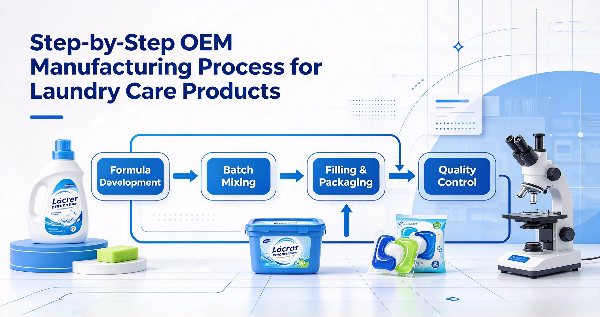
Professional B2B detergent procurement follows a standardized, repeatable workflow. Understanding the complete cooperation process helps buyers control project progress, avoid communication delays, and shorten the overall launch cycle of private label detergent products. Below is the full one-stop OEM manufacturing workflow for global importers:
1. Step 1: Sourcing & Inquiry Submission – Submit targeted demands including target market, product type, formula preference, packaging requirements, and order volume for customized solutions.
2. Step 2: Professional Quotation & Solution Confirmation – Manufacturers provide tailored pricing, MOQ rules, production cycle and service packages based on your demands.
3. Step 3: Free Sample Testing & Evaluation – Receive physical samples, verify detergency, fragrance, formula mildness and packaging quality for market adaptation.
4. Step 4: Formula & Packaging Optimization – Adjust formula concentration, scent, and customize brand packaging, logos and labels according to feedback.
5. Step 5: Artwork & Contract Finalization – Confirm packaging design drafts, sign formal cooperation contracts and clarify quality and delivery clauses.
6. Step 6: Formal Mass Production – Launch automated batch production with real-time process monitoring and parameter locking.
7. Step 7: Full Pre-Shipment QC Inspection – Complete batch testing of product quality, packaging integrity and specification compliance.
8. Step 8: Export Shipment & Document Handover – Finish container loading, arrange logistics, and deliver full sets of customs clearance documents.
9. Step 9: Long-Term After-Sales Support – Provide product iteration suggestions, reorder priority and technical after-sales service for long-term partners.
Professional Factory Audit Checklist for Detergent Sourcing
Instead of relying only on written quotations and static certificates, professional B2B buyers always conduct targeted on-site or virtual factory audits to validate real production strength. A qualified detergent manufacturing facility must own a complete, standardized production and quality management system. When auditing a potential manufacturing partner, focus on these core operational areas to avoid middlemen and unqualified small workshops:
• Automated liquid detergent mixing and fully enclosed filling lines for stable mass production
• In-house professional laboratory for real-time viscosity, pH value, formula stability and safety testing
• Independent dust-proof raw material warehouse with standardized ingredient storage and classification management
• Complete batch production records and full quality traceability system for every order
Real B2B Sourcing Case Study (Verified Export Project)
To reflect practical manufacturing and service strength, below is a real long-term cooperation case with a European supermarket distributor, with no exaggerated advertising descriptions:
A regional supermarket distributor in Eastern Europe sought to replace its original detergent supplier due to unstable batch fragrance performance and inconsistent packaging quality, which led to scattered consumer complaints and affected repeat purchase rates. After screening multiple Chinese manufacturers, the client selected our factory for sample blind testing and solution docking.
Our team optimized the formula fragrance retention and standardized packaging sealing processes according to the local market’s consumer preferences. After two rounds of sample verification and packaging scheme adjustment, the client placed a 20GP trial container order for market testing. Within six months of offline retail sales, stable product quality and unified packaging standards significantly reduced customer complaints and improved market recognition.
At present, both parties have maintained stable long-term cooperative relations, with regular monthly bulk orders and continuous minor product iteration optimization to adapt to market changes.
• Moisture-proof and dust-free finished goods warehouse for inventory preservation
• Standard container loading area with mature export shipment operation specifications
• Strict pre-shipment quality inspection procedures for all export batches
B2B Sourcing Decision Tree for Detergent Buyers
This intuitive decision tree helps you quickly screen whether a supplier is suitable for your project, avoiding mismatched cooperation and procurement risks:
Do you need custom OEM/PRIVATE LABEL services?
✅ YES → Do you need exclusive formula optimization and customization?
✅ YES → Choose professional laundry detergent manufacturer with independent R&D lab
❌ NO → Choose qualified factory with standardized packaging customization
❌ NO (Only wholesale stock goods)
✅ Stable bulk demand → Choose export-oriented direct factory
❌ Temporary small order → Reliable qualified trading company
You can use this checklist for supplier screening, factory audit scoring, and pre-order risk assessment. It fully adapts to supermarket procurement standards and private label brand project evaluation requirements, helping you systematically eliminate unqualified suppliers.
Author Profile & Content Credibility
Written by Senior Export Consultant | Reviewed by Senior Chemical Engineer| Reviewed by Senior Chemical Engineer
This professional sourcing guide is created and strictly reviewed by our core technical team. The reviewing engineer owns 15+ years of in-depth experience in household cleaning product R&D, OEM formula optimization and ISO9001 quality management system operation, specializing in global market compliance verification and cross-border standardized production management. Our team has long served supermarket chains, regional distributors and private label brand owners across Europe, Southeast Asia, the Middle East and other global regions.
Every piece of content on this page combines real factory production experience and actual cross-border sourcing cases to deliver practical, accurate and actionable supplier screening guidelines, helping global buyers avoid common sourcing risks and select stable long-term manufacturing partners. Last reviewed: July 2026