Release time:Nov 19,2026
Click amount:'4
By:Guangdong Richeng Technology Industry Co., Ltd
For independent retailers, launching a laundry detergent range under your own brand can be a way to increase margin, build customer loyalty and differentiate your store from competitors. But for a first-time buyer, the process raises many questions: what MOQ can you realistically work with, how customisable can the formula be, what documentation is needed, and how do you avoid committing to a large order before you have tested the market?
This guide walks a new retailer through the private label laundry detergent buying process — from assessing whether a private label range is right for your business, to choosing a formulation, understanding MOQ and packaging options, reviewing samples and placing the first production order. It is written for independent retailers, small chain buyers and first-time private label operators. For manufacturers supporting private label laundry and cleaning programs, visit https://www.gdricheng.com/.
Is Private Label Laundry Detergent Right for Your Store?
Before approaching suppliers, it helps to assess whether a private label detergent range matches your retail position.
• Customer base: Who are your shoppers — price-sensitive families, eco-conscious buyers, or customers looking for convenience sizes?
• Range gap: Is there a format, fragrance or pack size your current branded suppliers do not cover?
• Storage and turnover: Do you have storage space for bulk stock, and can you estimate realistic weekly or monthly sales?
• Regulatory and documentation requirements: Are you prepared to review product documentation, labelling and applicable requirements for your destination market?
A private label laundry detergent range often works well when the retailer has a clear sense of local demand. If demand is unproven, starting with a small number of SKUs and one or two pack sizes can reduce initial inventory exposure.
Understanding MOQ for Private Label Orders
Minimum order quantity (MOQ) is one of the first questions new retailers ask, and it varies by product, packaging type, customisation level and manufacturer.
• Product type: Standard liquid detergents, powders and fabric softeners may carry different MOQs.
• Packaging: Standard bottles or pouches may have lower MOQs than custom moulded packaging or bespoke artwork.
• Formula customisation: A standard existing formulation usually requires a lower minimum order than a fully developed custom formula.
• Order combination: Some manufacturers may allow multiple SKUs to be combined within an order, subject to product type and production arrangements.
• What is the MOQ per SKU and per order?
• Does the MOQ differ for standard versus customised formulations?
• Can several SKUs be combined to meet the minimum?
• Are there tiered pricing levels for larger repeat orders?
MOQ figures should be confirmed in writing for the specific product, pack size and packaging arrangement before samples or production are arranged.
Choosing a Formulation That Fits Your Market
Formulation decisions shape how the product performs, how it smells and how it positions on shelf. New retailers can usually choose between an existing standard formulation and a more customised option.
Standard versus custom formulations
• Standard formulation: The manufacturer's existing product, adjusted within available options such as fragrance or pack size. Standard formulations may involve less development work and fewer customisation steps than fully customised formulations, depending on the product and packaging requirements.
• Custom formulation: The formula is adjusted to meet specific performance, fragrance or positioning requirements. This may require additional sampling rounds, development discussion and a different MOQ or cost structure.
Formulation factors to discuss
• Target price and positioning: Whether the range is positioned as value, mid-range or premium, the target retail price, pack sizes and expected cost per use where applicable.
• Cleaning performance: Typical stains, wash temperatures and water hardness in your trading area.
• Fragrance: Fresh, floral or citrus profiles, depending on your target customers and available options.
• Foam profile: Suitable for the washing machines your customers commonly use.
• Concentration and dosage: Whether the product is standard or concentrated, and how the dose instruction should be presented.
• Positioning claims: Any environmental or performance claims you intend to make, and whether supporting documentation is available.
Explore our private label laundry and cleaning OEM capabilities to see the formulation and packaging options available for retailer programs.
Packaging, Labelling and Branding
Packaging is where your brand identity becomes visible to the shopper. For a first private label range, packaging decisions usually cover:
• Format: Bottle, pouch, refill pack or carton, depending on retail channel and storage.
• Pack size: Family sizes, value packs or smaller trial sizes for initial launch.
• Artwork and label: Logo, brand name, product description, ingredients, directions, warnings and local-language information where required.
• Artwork approval: Review and approve the packaging artwork and label proof before printing or producing customised packaging materials.
Any claims on the label — performance, fragrance, environmental or safety-related — should match the approved formulation and available documentation. Labelling requirements vary by destination market, so retailers should confirm applicable rules with a regulatory adviser.
Sample Review Before Committing to Production
Before placing a bulk order, retailers should review product samples under conditions relevant to their customers' use. For laundry products, this may include water hardness, washing temperature and machine type. Evaluate cleaning performance, fragrance, foam, viscosity and appearance. Record your observations and compare the sample against your intended product positioning and agreed specifications, then share specific feedback with the manufacturer.
The approved sample, together with the written specification and any agreed test criteria, becomes the reference standard for bulk production. Buyers should confirm whether revised samples and additional revision rounds carry any cost, and agree this in advance.
Documentation and Compliance for Retailers
Retailers importing or selling private label products are responsible for checking that documentation and labelling meet the requirements of their market. Typical supporting documents include:
• Product specifications for each SKU
• Safety Data Sheets (SDS), where applicable to the product and market
• Applicable test reports, where the product or claim requires them
• Packing list, commercial invoice and other export documents for the shipment
Additional certificates, registrations or labelling approvals may be required depending on the destination market. The manufacturer can provide supporting documentation based on the confirmed product, but the importer or retailer remains responsible for verifying local regulatory and customs requirements.
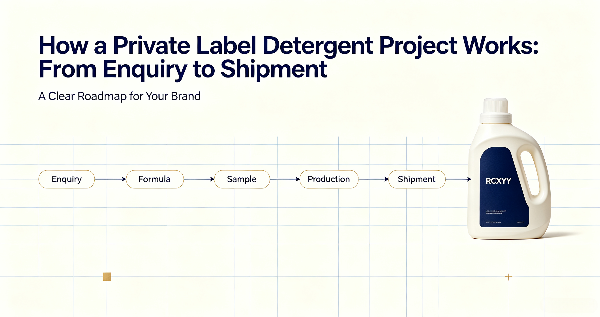
Ordering Process: From Enquiry to First Shipment
A typical first private label order follows this sequence:
1. Enquiry and brief: Share product category, pack sizes, fragrance direction, target price and destination market.
2. Quotation and MOQ confirmation: Review pricing, MOQ, lead time and commercial terms in writing.
3. Sampling and feedback: Test samples, provide structured feedback and approve the reference sample.
4. Packaging approval: Finalise artwork, label copy and packaging proof.
5. Production order: Confirm the order quantity, agreed specifications, production schedule and documentation requirements before bulk production begins.
6. Production, checks and loading: Quality checks at relevant stages, documentation preparation and container loading.
Selected laundry care, dishwashing and surface cleaning SKUs can often be combined in a mixed-SKU shipment, subject to product compatibility, packaging and loading requirements. Learn more about our mixed SKU container loading solutions.
How RCXYY Supports Independent Retailers
Guangdong Richeng Technology Industry Co., Ltd. (RCXYY) is a household cleaning product manufacturer based in Guangdong, China, supporting independent retailers and private label operators with laundry care and household cleaning programs. Our support covers:
• Requirement discussion: Understanding your customer profile, product positioning and pack-size plans before sample development.
• Formulation and sampling: Standard and adjusted formulations, with samples produced based on your requirements and revision rounds after feedback where applicable.
• Packaging customisation: Bottle, pouch and label options, with proof approval before packaging production.
• Production and documentation: Quality checks at relevant production stages, product specifications and Safety Data Sheets (SDS) prepared based on the confirmed formulation; applicable test reports can be coordinated subject to the required test scope.
For a firsthand look at our production facilities, consider scheduling a factory tour. Planning your first private label laundry detergent range? Share your target market, preferred product format, pack sizes and estimated order quantity with RCXYY to discuss suitable product and sourcing options. Contact our export team to request samples.
Q1: What is the minimum order quantity for a private label laundry detergent range?
MOQ varies by product, pack size, packaging type and whether the formulation is standard or custom. Some manufacturers allow multiple SKUs to be combined toward a shared minimum. Retailers should request per-SKU and per-order MOQ details for their specific product plan before committing.
Q2: Can a first-time retailer customise the fragrance and formula?
Customisation options depend on the manufacturer and the project. Standard formulations may offer fragrance selection within existing options, while a more adjusted formula may require additional sampling rounds and a higher order commitment. These possibilities should be discussed during the initial consultation.
Q3: How long does a first private label order take?
Timing varies with formulation complexity, sampling rounds, packaging development, order volume and production scheduling. Packaging design can run in parallel with formulation sampling, so total duration is not simply the sum of each stage. Confirm an indicative timeline with your manufacturer based on the specific project.
Q4: Do I need my own artwork before contacting a supplier?
No. Some manufacturers offer layout support based on your logo and brand details. You should however have a clear idea of your brand name, product description and any claims or information you want on the label. Artwork review and proof approval should take place before packaging production.
Q5: What documentation will I receive for a private label product?
Typical documents include product specifications, Safety Data Sheets (SDS) and applicable test reports where available. Additional certificates or registrations may be required depending on your destination market. Confirm the exact documentation list with the manufacturer and a regulatory adviser before launch.
Q6: Can I start with a small number of SKUs?
Many retailers launch with one or two products — for example, a liquid detergent in one or two pack sizes — then expand based on sales feedback. Starting narrow can reduce initial inventory and help you test which fragrance, format or price tier resonates with your customers.
Q7: Who is responsible for regulatory compliance of a private label product?
The importer or retailer remains responsible for verifying local regulatory, labelling and customs requirements. The manufacturer provides supporting documentation based on the confirmed product, but compliance for the destination market should be confirmed with a qualified regulatory adviser.
Launching a private label laundry detergent range as an independent retailer works most smoothly when you start with a clear customer profile, confirm MOQ and commercial terms early, review samples against your local conditions, and keep documentation and labelling aligned with your destination market. Starting with a focused, small range can make the first order easier to manage and easier to refine based on real sales feedback.
If you are preparing your private label laundry range, RCXYY supports retailers with requirement consultation, formulation sampling, packaging options and export documentation. Visit https://www.gdricheng.com/ to learn more, or contact our export team to discuss your product plan.
Note: MOQs, lead times, costs, documentation and customisation options vary by manufacturer, product category, destination market and commercial agreement. This article provides general guidance. Retailers should confirm all terms, specifications, regulatory and customs requirements with their chosen supplier before placing an order.