Release time:Nov 13,2026
Click amount:'4
By:Guangdong Richeng Technology Industry Co., Ltd
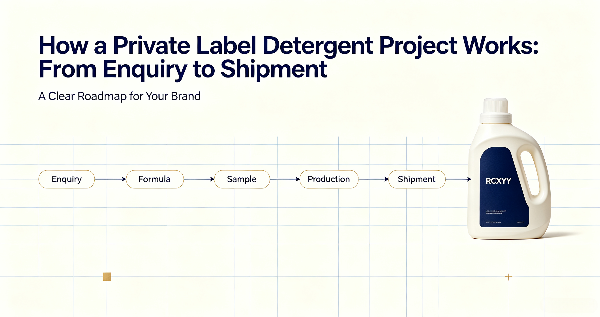
Starting a private label detergent range involves more than choosing a formula and a label. A project moves through requirement brief, formulation and sampling, packaging approval, production, quality control, documentation and container loading — and each stage involves tasks on both the brand owner's side and the manufacturer's side. When responsibilities are clear from the beginning, the project tends to move more smoothly, with fewer revisions and fewer surprises before shipment.
This guide walks through a typical private label detergent project from the first enquiry to the final container, explaining what each stage covers and where the brand owner and manufacturer each contribute. It is written for retail brand owners, supermarket suppliers, household cleaning product distributors, hospitality suppliers, importers and private label operators who want to understand how working with a private label detergent manufacturer operates in practice. Understanding this division helps buyers compare suppliers more clearly and prepare a project brief that matches what a manufacturer can deliver. For manufacturers supporting private label laundry and cleaning programs, visit https://www.gdricheng.com/.
What a Private Label Project Involves
In a private label arrangement, the brand owner sells products under its own brand name, while the manufacturer produces the goods to an agreed specification. Working with an experienced private label detergent manufacturer typically means the manufacturer provides formulation, production facilities, quality-control procedures and export documentation; the brand owner provides market knowledge, brand positioning, artwork and commercial decisions.
Before comparing suppliers, brand owners may find it useful to prepare:
• Target market and retail channel (supermarket, pharmacy, e-commerce, B2B)
• Product category (liquid detergent, powder, fabric softener, dishwashing liquid, surface cleaner)
• Performance expectations, fragrance direction and pack sizes
• Price tier and expected cost per use, where applicable
• Required documentation and destination-market requirements
Explore our private label laundry and cleaning OEM capabilities to see how a typical program is structured.
Stage 1: Requirement Brief and Initial Consultation
The project begins with a consultation where the brand owner shares its market goals and the manufacturer explains what products, formats and customisation options are available.
• Target country, retail channel and product positioning
• Product type, expected performance and preferred fragrance direction
• Pack sizes, price tier and target order quantity
• Any regulatory, certification or labelling requirements known for the destination market
• Available product ranges, pack formats and formulation options
• Indicative pricing, MOQ and sample lead time, based on the information provided and subject to project requirements
• Questions that help clarify the brief and identify feasible product concepts
A clear requirement brief reduces back-and-forth later and helps the manufacturer prepare an accurate quotation. At this stage, commercial terms, MOQ and payment conditions should be confirmed in writing before sample development proceeds.
Stage 2: Formulation Development and Sampling
Once the brief is agreed, the manufacturer prepares an initial formulation and product sample. This stage usually involves one or more revision rounds based on buyer feedback.
• Evaluating samples under conditions relevant to the intended application. For laundry products, this may include water hardness, washing temperature and machine type; for other cleaning categories, testing should follow the relevant usage conditions and product instructions
• Feedback on cleaning performance, fragrance, foam, viscosity and appearance, with specific comments and photos where possible
• Approval of the final sample once performance and sensory profile meet expectations
• Preparing the initial formula proposal and sample production
• Adjusting fragrance, foam, viscosity or formulation based on documented feedback
• Documenting the approved sample together with the agreed specifications and test criteria where applicable
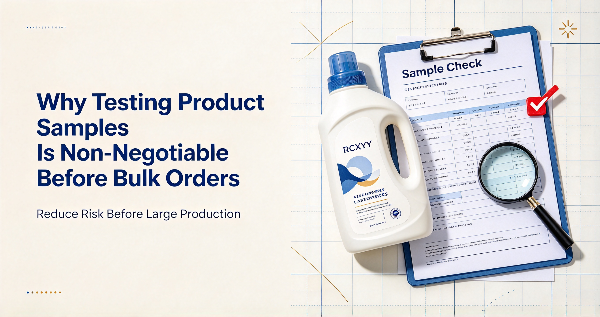
The approved sample becomes the reference standard against which bulk production is checked. Buyers should confirm whether revised samples, sample fees and additional revision rounds carry any cost, and agree this in advance.
Stage 3: Packaging and Artwork Approval
Packaging development often runs in parallel with formulation sampling. This stage covers bottles, pouches, cartons, labels and artwork.
• Brand artwork, logo, label copy and any marketing claims to appear on the packaging
• Confirmation of required labelling elements, such as ingredients, directions, warnings and local-language information
• Review and sign-off on the artwork proof before packaging materials are produced
• Available packaging formats and their compatibility with the relevant production line
• Artwork layout preparation, label dimensions and printing specifications
• Proof review and revision support before packaging production
Proof approval is the final opportunity to correct text, colours and layout before packaging materials are produced. Buyers should check that claims on the label match the approved formulation and any available test documentation. Regulatory labelling requirements vary by destination market and should be confirmed with a regulatory adviser.
Stage 4: Pre-Production Confirmation
Before bulk production begins, both sides confirm the production basis so that manufacturing proceeds against an agreed reference.
• Confirmation of the approved sample, final artwork and packaging specifications
• Approval of the production order quantity, delivery schedule and commercial terms
• Any destination-market documentation or certification requests to be prepared
• Confirmation of production capacity, raw material availability and estimated lead time, based on current production planning and the agreed order quantity
• Preparation of product specifications and supporting documentation based on the confirmed formulation
• Internal production plan aligned with the approved sample and artwork
Changes introduced after this stage may affect lead time, cost or packaging, so both sides should record what was agreed before production starts.
Stage 5: Bulk Production and Quality Control
Bulk production runs against the approved reference sample and confirmed specifications. Quality checks are carried out at relevant stages of production, based on the product category and agreed specifications.
• Monitoring production progress and responding to questions from the manufacturer
• Arranging any third-party inspection or pre-shipment review for the order, where required
• Quality checks at relevant production stages, with the specific checks varying by product category and agreed specifications
• Production records retained where applicable to support consistency across repeat orders
• Handling of any quality issues identified during production, in line with agreed procedures
Buyers should note that production variables such as raw material batches and storage conditions can affect finished product. Working from an approved sample, written specifications and batch records helps support consistency; pre-shipment inspection remains an additional option for larger orders.
Stage 6: Documentation, Inspection and Container Loading
The final stage prepares the order for export and shipment.
• Confirmation of shipping terms, delivery destination and required export documents
• Coordination with the freight forwarder, customs broker or regulatory adviser as needed
• Review of final documentation before departure
• Product specifications, Safety Data Sheets (SDS) and applicable test reports, where available and based on the confirmed product and destination-market requirements
• Packing list, commercial invoice and other standard export documents
• Container loading, with liquids and powders separated as appropriate, subject to product compatibility, packaging and loading requirements
Importers remain responsible for verifying local regulatory and customs requirements. Additional certificates or test reports may be required depending on the destination market, and buyers should confirm these before production rather than after shipment.
Responsibility Division at a Glance
Stage | Brand owner | Manufacturer |
Requirement brief | Market, positioning, pack size, target price | Product options, indicative pricing, MOQ, lead time |
Formulation and sampling | Sample testing, feedback, final approval | Formula proposal, sample production, revisions, reference sample |
Packaging and artwork | Artwork, label copy, claims, proof sign-off | Format options, layout, printing specs, proof revision |
Pre-production | Order approval, quantity, schedule, documentation requests | Capacity check, specifications, production plan |
Production and QC | Progress monitoring, optional inspection | Quality checks at relevant stages, production records where applicable |
Documentation and loading | Shipping terms, forwarder coordination, document review | Specifications, SDS and test reports where applicable, loading |
This table reflects a typical project structure; actual responsibilities may vary by manufacturer, product and commercial agreement.
How RCXYY Supports Private Label Detergent Projects
Guangdong Richeng Technology Industry Co., Ltd. (RCXYY) is a household cleaning product manufacturer based in Guangdong, China, supporting international retail brand owners with laundry care and household cleaning projects. As a private label detergent manufacturer working with buyers across multiple markets, our process covers:
• Requirement consultation: Understanding target market, product positioning and performance expectations before sample development.
• Formulation and sampling: Sample production based on buyer requirements, with adjustment rounds after feedback where applicable.
• Packaging customisation: Support for bottle, pouch and label formats, with proof approval before packaging production.
• Production and QC: Quality checks at relevant production stages, with production records maintained where applicable to support repeat-order consistency.
• Documentation and loading: Product specifications and Safety Data Sheets (SDS) prepared based on the confirmed formulation; applicable test reports can be coordinated subject to the required test scope. Mixed-SKU loading can be arranged subject to product compatibility, packaging and loading requirements. Learn more about our mixed SKU container loading solutions.
For a firsthand look at our production facilities, consider scheduling a factory tour. To discuss your private label detergent project and request samples, contact our export team.
Q1: What information should I prepare before contacting a private label detergent manufacturer?
It helps to know your target market, retail channel, product type, preferred fragrance direction, pack sizes, target order quantity and any destination-market documentation requirements. You do not need a fully finished specification at the first contact; the manufacturer can help clarify feasible options based on your brief.
Q2: How long does a typical private label detergent project take?
Timing varies with formulation complexity, sampling rounds, packaging development, order volume and production scheduling. Packaging design can run in parallel with formulation sampling, so total project duration is not simply the sum of each individual stage. Buyers should confirm an indicative timeline with their manufacturer based on the specific project.
Q3: Who owns the product formulation in a private label arrangement?
Ownership, exclusivity and intellectual-property arrangements depend on the contract and formulation development agreement. This should be discussed and agreed in writing with the manufacturer before development begins, particularly if the brand owner requires specific exclusivity or formulation ownership terms.
Q4: Can I request changes to the formula or packaging after samples are approved?
Changes may be possible, but modifications after sample approval can affect formulation, packaging cost, lead time and existing documentation. Buyers should document any requested changes clearly and confirm the impact on cost and schedule with the manufacturer before proceeding.
Q5: What documentation should I expect from the manufacturer?
Typical supporting documents include product specifications, Safety Data Sheets (SDS) and applicable test reports, where available. Additional certificates or labelling documents may be required depending on the destination market. Buyers should confirm the exact documentation list for their target market with the manufacturer and a regulatory adviser.
Q6: Is a pre-shipment inspection necessary for private label orders?
Inspection requirements vary by order size, retail channel and buyer preference. Many brand owners arrange third-party pre-shipment inspection for larger orders to check quantity, packaging, labelling and appearance before departure. Whether inspection is required should be decided alongside the supplier agreement.
Q7: Can multiple product categories be combined in one shipment?
Selected laundry care, dishwashing and surface cleaning SKUs can often be combined in a mixed-SKU shipment, subject to product compatibility, packaging and loading requirements. Buyers should confirm the combination with the manufacturer when planning the order.
A private label detergent project runs most smoothly when both sides agree on responsibilities early, and the approved sample, packaging, specifications and documentation are confirmed before bulk production. RCXYY supports retail brand owners with product development, sampling, packaging, production and export documentation.
Visit https://www.gdricheng.com/ to learn more, or contact our export team to discuss your project.
Note: Project timelines, MOQs, costs, documentation and division of responsibilities vary by manufacturer, product category, destination market and commercial agreement. This article provides general guidance. Buyers should confirm all terms, specifications, regulatory and customs requirements with their chosen supplier before placing an order.