Release time:Sep 30,2026
Click amount:'0
By:Guangdong Richeng Technology Industry Co., Ltd
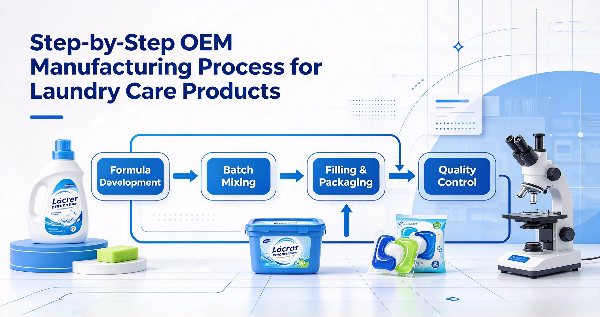
Launching a private label laundry care product involves more than sending a packaging design to a factory. A structured OEM detergent process helps private label operators move from concept to shelf with fewer surprises — clearer expectations on timeline, quality, documentation and delivery. Whether you are launching your first laundry liquid line or expanding an existing range, understanding each step of the manufacturing workflow makes it easier to brief suppliers, review samples and manage production schedules.
This guide walks through the typical stages of an OEM detergent process, from initial requirement discussion to container loading. It is written for private label operators, brand managers and sourcing teams who want a practical overview of how laundry care products are developed, sampled, produced and exported. For manufacturers that support end-to-end OEM laundry care development, visit https://www.gdricheng.com/.
Step 1: Requirement Brief & Market Alignment
The first stage is not production — it is information gathering. A clear requirement brief reduces back-and-forth later and helps the manufacturer quote accurately. Private label operators typically provide:
• Target market and retail channel: Which country or region the product will sell in, and whether it is for supermarkets, pharmacies, e-commerce or B2B distribution.
• Product category: Laundry liquid, washing powder, fabric softener, or a combination. Each has different formulation, packaging and documentation requirements.
• Positioning and price target: Value, mid-tier or premium positioning, and the expected retail price point or cost target.
• Key performance expectations: For example, low-temperature washing performance, fragrance profile, concentrated or ready-to-use format, or specific claims the brand wants to communicate.
• Pack size and format preferences: Bottles, pouches, refills, drums or sachets, with target volumes and any preferred bottle shapes.
• Regulatory considerations: Any known destination-market requirements, restricted ingredients, or certification targets the brand needs to meet.
At this stage, the manufacturer confirms feasibility — whether the requested product, pack size and price target can be developed — and provides an indicative quotation and lead-time estimate. This is also when private label operators should ask about MOQ, sample fees and the approval workflow before committing to a project.
Step 2: Formulation Development & Sampling
Once the requirement brief is agreed, the manufacturer's R&D team develops or selects a formulation that matches the product brief. For laundry care, this typically involves adjusting surfactant levels, fragrance, viscosity, pH and dosing recommendations.
The sampling process usually follows this flow:
1. Initial formula proposal: The manufacturer suggests a base formula aligned with the target market and positioning. Buyers may request adjustments to fragrance, strength or format.
2. Sample production: Small-batch samples are produced for the buyer to test — evaluating cleaning performance, fragrance, appearance, viscosity and packaging compatibility.
3. Feedback and revision: The buyer provides feedback on the samples. Minor adjustments to fragrance intensity, thickness or scent profile are common at this stage.
4. Pre-production sample confirmation: Once the buyer approves a final sample, it becomes the reference standard against which bulk production is checked.
Buyers should treat the approved sample as a formal reference point. Retaining both physical samples and written test data helps resolve any questions about consistency when bulk production arrives. The final approved sample should be documented together with the agreed specifications and test criteria where applicable. The number of sampling rounds varies by project — simple adjustments may take one or two rounds, while fully customised formulations may require more.
Step 3: Packaging Design & Artwork Approval
Parallel to formulation development, packaging design and artwork preparation begin. This stage covers bottle or pouch selection, label artwork, carton design and any secondary packaging requirements.
Key considerations include:
• Pack format selection: Bottle material, cap type, handle design, pouch format or sachet size. The manufacturer can advise on available packaging formats and their compatibility with the relevant production line.
• Artwork preparation: The brand provides logo, design files and copy. The manufacturer or its packaging supplier adapts the artwork to the actual label dimensions and printing process.
• Regulatory labelling check: Ingredient lists, net content, usage instructions, country-of-origin markings and any required safety or recycling symbols should be reviewed against destination-market requirements. Buyers should confirm local labelling obligations with their regulatory adviser.
• Proof approval: A printed proof or mock-up is approved before mass printing. This is the final opportunity to correct text, colours and layout before packaging materials are produced.
Clear artwork approval reduces the risk of costly reprints. Buyers should confirm spelling, net content volume, language accuracy and any regulatory symbols at this stage.
Step 4: Pre-Production Validation
Before bulk production starts, the manufacturer typically conducts a pre-production review. This stage confirms that the approved sample, packaging materials and production schedule are aligned.
Activities at this stage may include:
• Final sample sign-off: The approved sample is confirmed as the production reference.
• Material readiness check: Raw materials, packaging components and label stock are ordered and received.
• Production scheduling: The order is placed in the production calendar, and the buyer receives a confirmed production start date and estimated completion date.
• Documentation preparation: Product specifications and Safety Data Sheet (SDS, commonly referred to as MSDS) documentation are prepared based on the confirmed formulation.
For first-time projects, buyers may request a pre-production inspection or a small trial batch before full-scale production. This can help identify any issues before a full container of goods is committed.
Step 5: Bulk Production & Quality Control
Once pre-production validation is complete, bulk production begins. The manufacturer mixes the formulation on production lines, fills bottles or pouches, applies labels and packs finished goods into cartons.
Quality control typically runs at several points:
• Incoming material inspection: Raw materials and packaging components are checked before production starts.
• In-process checks: Viscosity, pH, fill volume and sealing are monitored during production.
• Finished product testing: Finished batches are tested against the approved sample for appearance, fragrance, performance and packaging integrity.
• Batch documentation: Production records and quality-control documentation are maintained for each batch to support consistency across repeat orders.
Production lead time varies depending on formulation complexity, packaging availability, order volume and production scheduling. Buyers should confirm estimated timelines with their manufacturer before placing a bulk order, and allow additional time for sampling and artwork revisions.
Step 6: Documentation & Export Preparation
As production completes, export documentation is prepared. For laundry care products, this typically includes product specifications, Safety Data Sheet (SDS) documentation, packing lists and commercial invoices. Additional certificates or test reports may be required depending on the destination market.
Buyers should confirm which documents are needed for their specific market — requirements vary by country and product classification. The manufacturer can provide supporting documentation, but importers remain responsible for verifying local regulatory and customs requirements with their customs broker or regulatory adviser.
For multi-category orders covering laundry liquid, fabric softener, dishwashing liquid or surface cleaners, buyers should confirm that documentation is consistent across all SKUs in the shipment.
Step 7: Container Loading & Shipment
The final stage is container loading. Finished cartons are packed into containers, with loading plans designed to maximise space utilisation while protecting product integrity. For mixed-SKU shipments, different products are loaded in an organised sequence — typically with liquids and powders separated as appropriate.
Buyers may request loading photos, carton dimensions and loading reports before departure. For repeat orders, established loading patterns can be reused to streamline the process. Learn more about our mixed SKU container loading solutions.
After loading, the shipment proceeds to the port and onward to the destination market. Buyers should track the shipment, prepare customs clearance documents and plan receipt and distribution schedules.
Typical OEM Detergent Process Timeline
The stages below may overlap. For example, packaging development can proceed in parallel with formulation sampling, so total project duration is not simply the sum of every individual stage. While exact timelines vary by project, a typical OEM detergent process for a new private label product may look like this:
Stage | Typical Duration | Key Activity |
Requirement brief & quotation | 1–2 weeks | Product specification, price confirmation, MOQ agreement |
Formulation sampling & revisions | 2–6 weeks | Sample production, buyer testing, formula adjustments |
Packaging design & artwork | 2–4 weeks | Pack format selection, artwork proof, label approval |
Pre-production validation | 1–2 weeks | Sample sign-off, material ordering, scheduling |
Bulk production | 2–4 weeks | Manufacturing, filling, labelling, QC checks |
Documentation & loading | 1 week | Export documents, container loading |
These ranges are illustrative. Actual timelines depend on product complexity, packaging customization, sampling rounds, order volume and production schedule. Buyers should confirm estimated lead times for each stage with their manufacturer.
How RCXYY Supports Your OEM Laundry Care Project
Guangdong Richeng Technology Industry Co., Ltd. (RCXYY) is a full-category household cleaning product manufacturer based in Guangdong, China, with over 22 years of export experience. We support private label operators across multiple overseas markets.
Our OEM detergent process covers:
• Requirement consultation: We work with buyers to define product specifications, positioning and packaging requirements based on the target market.
• Formulation development & sampling: Our R&D team develops laundry liquid, washing powder and fabric softener formulations, with samples provided for buyer testing and feedback. Explore our private label laundry and cleaning OEM capabilities.
• Packaging customization: Multiple bottle and pouch formats can be customized according to project requirements, with artwork support and proof approval.
• Production & quality control: Production records and quality-control documentation are maintained to support consistency across repeat orders.
• Documentation & export support: We can provide product specifications, Safety Data Sheet (SDS) documentation and applicable test reports for each SKU. Buyers should confirm any additional local requirements before shipment.
• Mixed-SKU container loading: Selected laundry care, dishwashing and surface cleaning SKUs can be combined in a single shipment, subject to product compatibility, packaging and loading requirements.
For a firsthand look at our production facilities and quality-control procedures, consider scheduling a factory tour. To request product samples, specifications and a tailored quotation, contact our export team.
Q1: How long does a typical OEM detergent process take from inquiry to shipment?
A new private-label laundry care project may take around 8–16 weeks in a typical case, but actual timing varies significantly according to formulation complexity, sampling rounds, packaging development, order volume and production scheduling. Buyers should confirm estimated timelines for each stage with their manufacturer.
Q2: Can I modify an existing formula rather than develop one from scratch?
Yes. Many private label projects start from an existing base formula and adjust fragrance, strength, viscosity or pack size. This approach can shorten the sampling cycle compared to developing a completely new formulation from the ground up.
Q3: What should I prepare before contacting an OEM manufacturer?
A clear product brief helps: target market, product category, positioning, expected retail price point, preferred pack sizes, key performance expectations and any known regulatory or certification requirements. Even a rough brief gives the manufacturer enough information to provide an indicative quotation.
Q4: How many sample rounds should I expect?
Simple adjustments — such as changing fragrance or pack size — may require one or two sample rounds. More complex formulation development, custom fragrance creation or regulatory-specific formulations may require additional rounds. Buyers should clarify the sampling process and sample fees before starting the project.
Q5: What documentation will I receive with my shipment?
Typical documents include product specifications, Safety Data Sheet (SDS), packing list and commercial invoice. Additional test reports or certificates may be available depending on the product and destination market. Buyers should confirm which documents are required for their specific customs and regulatory needs.
Q6: Can I combine laundry care and other cleaning products in one container?
Yes, depending on product compatibility, packaging and loading requirements. Mixed-SKU container loading allows buyers to combine laundry liquid, fabric softener, dishwashing liquid and surface cleaners in a single shipment. Buyers should discuss SKU combinations and loading plans with the manufacturer before ordering.
Understanding the OEM detergent process helps private label operators plan more effectively, communicate clearly with manufacturers and reduce the risk of misunderstandings at each stage. From requirement brief through formulation sampling, packaging approval, bulk production, documentation and container loading — each step builds on the previous one, and clear expectations at the front end lead to smoother execution later.
If you are planning a new private label laundry care line or expanding an existing range, RCXYY supports private label operators with structured formulation development, packaging customisation and coordinated export documentation support. Visit https://www.gdricheng.com/ to learn more, or contact our export team to request samples and a tailored quotation for your project.
Note: Production timelines, MOQ, sampling processes and documentation requirements vary by manufacturer, product and destination market. This article provides a general overview of the OEM process and does not constitute a commitment of specific terms. Buyers should confirm all details directly with their chosen manufacturing partner.