Release time:Sep 23,2026
Click amount:'1
By:Guangdong Richeng Technology Industry Co., Ltd
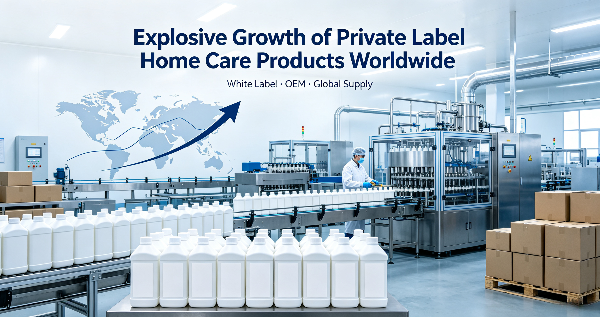
Private label home care has moved from a niche value play to a strategic growth lever for retail chains. What was once a small collection of generic, low-price alternatives has evolved into a multi-category portfolio that spans laundry care, dishwashing, surface cleaners and eco-certified formulations — often developed, branded and sold under the retailer's own name. For retail chain buyers, the shift raises a practical question: how should your organization position, launch and scale a private label home care range in the current market?
This guide examines the growth drivers behind own-brand home care, the entry window still open for new and expanding ranges, and the differentiation strategies that retailers can use to build a credible, repeat-purchase product line. It is written for retail chain buyers, category managers and private label teams evaluating sourcing, formulation and manufacturing partnerships. For manufacturers that support own-brand home care development across laundry and household cleaning categories, visit https://www.gdricheng.com/.
Market Growth: Why Private Label Home Care Is Expanding
Several converging trends are supporting the expansion of retailer-branded home care products worldwide:
• Retailer margin pressure: As national brand pricing comes under scrutiny, retailers are looking to own-brand ranges to protect margin while remaining price-competitive. MarkNtel Advisors estimates the broader global private-label market will grow at a CAGR of approximately 9.15% from 2026 to 2032. This wider private-label trend provides context for the continued expansion of retailer-owned product ranges, including household care. (Source: MarkNtel Advisors, Global Private Label Market Research Report, May 2026.)
• European private-label penetration: Across 17 European markets, private-label products reached a 38.8% value share of the grocery market in the latest NielsenIQ data cited by PLMA. This broader retail trend provides useful context for the expansion of retailer-owned ranges, including home care. (Source: NielsenIQ / PLMA, latest 52-week data through W52 2025.)
• Price positioning: One industry estimate places retailer-branded home-care products at around 25% below comparable branded alternatives, although actual pricing varies by category, pack size and market. (Source: Expert Market Research, Home Care Market Report, June 2026.)
• Retailer investment in eco-ranges: Woodstone Research observes that retailers including Aldi, Lidl, Tesco and Kroger are investing in eco-certified private-label ranges that compete with national brands on both performance and sustainability credentials. (Source: Woodstone Research, Household Cleaning Products Market, May 2026.)
These figures are directional estimates from different research providers, each using its own market definition and methodology. The overall direction — sustained growth in own-brand home care share — is consistent across multiple sources, even when the exact percentages differ.
The Entry Window: Is It Still Open for New Private Label Ranges?
Retailers that moved early into own-brand home care have already captured meaningful shelf space. That does not mean the opportunity has closed. Several factors suggest the entry window remains open for new and expanding ranges:
• Category fragmentation: Home care is not a single homogeneous category. Laundry, dishwashing, fabric care and multi-surface cleaning each have different shopper expectations, price points and regulatory requirements. A retailer can enter one category well without competing on every shelf line.
• Regional growth: Global Market Insights estimates private label at around 12–15% of North American cleaning-products market sales, with growth of approximately 5–6% annually. (Source: Global Market Insights, North America Cleaning Products Market, August 2026.) Lower-penetration markets may still offer room for retailers to build share before national brands adjust.
• Consumer trust shift: As retailers invest in formulation quality, packaging design and eco-certification, shoppers are becoming more willing to try own-brand options. The challenge for new entrants is no longer convincing shoppers to try the product — it is offering a credible reason to choose it.
• Online and private label convergence: E-commerce channels reduce the barrier to launching a focused private label range, as retailers can test demand with a limited SKU set before expanding shelf space.
For retail chain buyers, the practical implication is that the question is no longer "should we enter own-brand home care?" but "which categories, price tiers and positioning will work for our shopper base?"
Differentiation Strategies Beyond Price
A competitive private-label range does not have to be the cheapest option on the shelf. The stronger opportunity is to combine an appropriate price position with clear product differentiation, reliable quality and consistent supply. Competing on price alone is increasingly crowded. Successful own-brand home care ranges combine price advantage with one or more differentiation layers. Retail chain buyers typically evaluate the following dimensions:
1. Formulation Differentiation
Rather than matching national brands on the same formula, retailers can work with manufacturers to develop formulations tailored to local shopper habits — for example, low-temperature performance in markets where cold-water washing is common, or concentrated formats for urban households with limited storage. Formulation flexibility allows a private label range to address specific regional needs without directly competing head-to-head on the national brand's strongest claims.
2. Eco-Certified and Sustainable Positioning
Many retailers are launching eco-certified private label ranges that address biodegradability, packaging recyclability and reduced environmental impact. This is not a universal claim that applies to every product; specific certification and biodegradability requirements vary by destination market and should be verified against local regulatory frameworks. A credible sustainability positioning requires product-specific testing and documentation rather than generic marketing language.
3. Pack Size and Price Tier Architecture
A well-designed private label range typically spans multiple pack sizes and price tiers — from value entry packs to premium larger formats. This allows the retailer to capture price-sensitive shoppers while also offering trade-up options. When evaluating a supplier, buyers should confirm the range of pack sizes, bottle formats and label customization available, and whether the manufacturer can support mixed-SKU container loading across categories.
4. Fragrance and Sensory Experience
Fragrance can be an important part of the home-care purchase and usage experience. Distinctive, well-tested fragrance profiles may help a private-label range develop a clearer sensory identity on shelf. Manufacturers that provide fragrance sampling and formulation adjustment allow retailers to test scent options before committing to a full production run.
5. Regulatory and Documentation Support
For retail chains selling across multiple regions, consistent documentation across SKUs is essential. A Safety Data Sheet (SDS, commonly referred to as MSDS), product specifications and applicable test reports should be available for each SKU. Buyers should confirm that the manufacturer can provide documentation aligned with destination-market requirements, and that additional local certification or labelling obligations are identified before shipment.
How to Structure an Own-Brand Home Care Range
Retail chain buyers planning a launch or expansion typically go through the following steps:
1. Category selection: Start with one or two high-frequency, high-rotation categories (such as laundry liquid or dishwashing liquid) rather than attempting a full portfolio at launch.
2. Consumer insight validation: Use existing shopper data, basket analysis and competitor gap analysis to identify which categories are under-served or where own-brand pricing can add value.
3. Supplier evaluation: Assess manufacturing capability, formulation flexibility, packaging customization, documentation support and MOQ flexibility. Consider scheduling a factory tour to verify production and quality-control procedures firsthand.
4. Sample and formulation testing: Request physical samples for cleaning performance, fragrance, viscosity and packaging evaluation before approving mass production.
5. Pilot launch: Test the range in selected stores or regions, gather shopper feedback and sales data, then refine the assortment before a wider rollout.
This phased approach helps reduce initial inventory exposure and allows the retailer to learn from real-market response before committing to a full range.
How RCXYY Supports Private Label Home Care Programs
Guangdong Richeng Technology Industry Co., Ltd. (RCXYY) is a full-category household cleaning product manufacturer based in Guangdong, China, with over 22 years of export experience. We support retail chains, distributors and private label brands across multiple overseas markets.
Our own-brand home care capabilities include:
• Multi-category formulation range: Laundry liquid, washing powder, fabric softener, dishwashing liquid and surface cleaners, helping retailers coordinate multiple household-care categories with one manufacturing partner.
• Formulation and fragrance customization: Buyers can work with our team to adjust formulations, fragrance profiles and packaging formats according to their target market requirements. Explore our private label laundry and cleaning OEM capabilities.
• Product-specific documentation: We can provide product specifications, Safety Data Sheet (SDS) documentation and applicable test reports for each SKU. Buyers should confirm any additional local requirements before shipment.
• Mixed-SKU container loading: Selected SKUs across laundry care, dishwashing and surface cleaning can be combined in a single shipment, subject to product compatibility, packaging and loading requirements. Learn more about our mixed SKU container loading solutions.
• Quality-control documentation: Production records and quality-control documentation are maintained to support consistency across repeat orders.
To request product specifications, samples and a tailored quotation for your private label program, contact our export team.
Q1: Is own-brand home care still a growing category in 2026?
Yes. Available industry research continues to indicate growth in private-label retail, although the scale and growth rate vary significantly by market, category and measurement method. For example, NielsenIQ data cited by PLMA shows private-label value share across 17 European grocery markets reached 38.8% through MAT W52 2025. Buyers should verify the specific figures relevant to their region and product category.
Q2: What is a realistic price advantage for own-brand home care versus national brands?
Some industry estimates place retailer-branded home-care products around 20–25% below comparable national-brand products, but actual pricing varies by category, pack size, retailer cost structure and local competitive landscape.
Q3: Which categories are suitable for a first own-brand home care launch?
High-frequency, high-rotation categories such as laundry liquid, dishwashing liquid and multi-surface cleaners are common starting points. These categories have predictable demand, clear shopper habits and established private label precedents, making them practical starting points for a first launch.
Q4: What MOQ should a retail chain expect for own-brand home care?
MOQ varies by product, packaging specification, customization level and manufacturer. Buyers should request MOQ details for each SKU during supplier evaluation and confirm whether the manufacturer offers trial-order arrangements for initial launches.
Q5: Can a private label range be eco-certified?
Yes, but certification requirements vary by country and product category. Buyers should identify the specific eco-label or certification relevant to their target market and work with a manufacturer that can support the required formulation, testing and documentation.
Q6: How long does it take to develop and launch an own-brand home care product?
Timelines vary depending on formulation complexity, packaging design, sample approval and production scheduling. Buyers should confirm estimated lead times, sample procedures and the approval workflow with their manufacturer before placing a bulk order.
Private label home care is no longer a side shelf strategy. Retailers that invest in formulation quality, packaging design and category management are building own-brand ranges that compete meaningfully with national brands on price, performance and shopper loyalty. The growth window is not unlimited — but it is still open for retail chains that approach private label as a structured, category-driven program rather than a simple import-and-relabel exercise.
If your team is evaluating a new or expanded own-brand home care range, RCXYY supports retail chains with multi-category formulation, product-specific documentation and flexible mixed-SKU export solutions. Visit https://www.gdricheng.com/ to learn more, or contact our export team to request specifications and samples for your market.
Retail / Private-Label Market
• NielsenIQ / PLMA — private-label value share across 17 European grocery markets, MAT W52 2025: 38.8% value share; broader retail trend, not home-care-specific
• MarkNtel Advisors — Global Private Label Market Research Report, May 2026: global private-label market CAGR approximately 9.15% (2026–2032); broader private-label trend, not home-care-specific
Cleaning Market & Pricing Context
• Woodstone Research — Household Cleaning Products Market, May 2026: retailers including Aldi, Lidl, Tesco and Kroger investing in eco-certified private-label ranges
• Global Market Insights — North America Cleaning Products Market, August 2026: private label estimated at 12–15% of North American cleaning-products market sales, growing approximately 5–6% annually
• Expert Market Research — Home Care Market Report, June 2026: one industry estimate places retailer-branded home-care products around 25% below comparable branded alternatives
Note: The sources above cover different market definitions — global private-label retail, European grocery, North American cleaning products, and home-care pricing. These figures are directional estimates and should not be combined as a single "private label home care market" statistic. Regulatory, certification and labelling requirements vary by destination market. This article provides general guidance and does not constitute legal or regulatory advice.