Release time:Oct 14,2026
Click amount:'0
By:Guangdong Richeng Technology Industry Co., Ltd
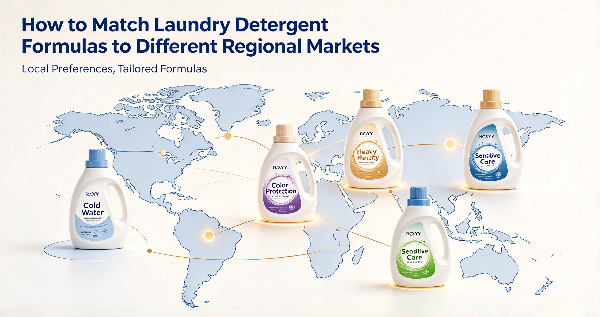
Laundry detergent is not a one-size-fits-all product. Water hardness, washing temperature, machine types, fragrance preferences, fabric habits and regulatory requirements vary significantly from region to region — and a formulation that performs well in one market may underperform in another. For multi-country importers, understanding these differences is essential for building a product range that resonates with local consumers and meets destination-market requirements.
This guide examines how laundry detergent for different markets should be adapted across three major regions — Southeast Asia, Europe and North America, and the Middle East — covering water quality, fragrance preferences, formulation adjustments and regulatory considerations. It is written for multi-country importers, regional distributors and brand owners who source laundry care products and sell across more than one market. For manufacturers that support region-specific formulation development, visit https://www.gdricheng.com/.
Why Regional Formulation Matters
Several factors drive the need for region-specific laundry detergent formulations:
• Water hardness: Hard water reduces the effectiveness of surfactants and can leave residue on fabrics. Depending on the formulation, manufacturers may consider suitable surfactant systems, builders or chelating agents. The appropriate approach should be determined through formulation testing rather than by increasing surfactant levels alone.
• Washing temperature: Cold-water washing is common in some markets (especially warmer climates), while hotter washes remain standard in others. Enzyme and surfactant formulations may need to perform across different temperature ranges.
• Machine types: Top-loading and front-loading washing machines have different foam tolerances. High-sudsing formulas may be suitable for top-loaders but can cause issues in front-load machines.
• Fragrance culture: Preferred scent profiles vary — from fresh and floral in some markets to stronger, long-lasting fragrances in others.
• Regulatory requirements: Ingredient restrictions, phosphate limits, biodegradability rules, labelling and packaging requirements differ by country and region.
Buyers should work with a manufacturer that can adjust formulations based on the target market rather than assuming laundry detergent for different markets can share a single formula. Explore our private label laundry and cleaning OEM capabilities.
Southeast Asia: Tropical Climate, Local Washing Habits
Many Southeast Asian markets have warm to hot climates year-round. Consumers often wash at lower temperatures, and hand washing or semi-automatic top-loading machines remain common in some markets. Water quality varies — some areas have moderately hard water, while others have softer water depending on the local supply.
• Foam profile: Foam expectations vary by country, washing method, machine type and consumer preference. In top-loading and hand-washing contexts, buyers may find that some consumers prefer richer foam. If the target market uses front-loading machines, lower-foam formulations may be more appropriate. Buyers should validate the preferred foam profile through local market research and sample testing.
• Dissolution speed: Products that dissolve quickly in cold or room-temperature water are advantageous in markets where hot water is less commonly used.
• Fragrance considerations: Fresh, clean scents — such as floral, citrus or "fresh linen" profiles — may serve as a starting direction for Southeast Asian markets. Fragrance profiles should be selected through target-market research and buyer sample evaluation rather than relying solely on regional assumptions.
• Pack sizes: Family-sized liquid bottles and economical powder packs are common, depending on the retail channel and average household size.
Ingredient, labelling and packaging requirements vary by Southeast Asian country. Buyers should confirm the applicable regulations for each destination market — including any restricted substances, import documentation and local language labelling requirements — with their regulatory adviser or customs broker.
Europe and North America: Low-Temperature Washing, Machine Diversity and Product Positioning
Washing machine preferences and washing habits differ across European and North American markets. Front-loading machines are common in many European markets, while top-loading machines remain significant in the United States. Lower-temperature washing is an important formulation consideration in many European markets. Buyers should assess the temperature settings commonly used in their target market and confirm product performance under the intended washing conditions. Water hardness also varies within both regions, and buyers should confirm local water quality information rather than relying on regional generalisations.
• Low-temperature performance: Formulas designed for lower-temperature washes may incorporate enzyme systems and surfactant blends. Buyers should confirm that enzyme-containing formulations are appropriate for their target market and that product performance is validated under the intended washing conditions.
• Foam and machine compatibility: Foam requirements depend on the machine mix in the target market. Front-loading machines generally require lower-sudsing formulations, while top-loading machines may accommodate richer foam. Buyers should identify the dominant machine types in their retail channel.
• Concentrated formats: Concentrated and ultra-concentrated laundry liquids have grown in popularity in Western markets, driven by sustainability concerns and shipping efficiency. Buyers should note that "concentrated" is not a universally defined term — dosage instructions should be clear and appropriate for the product.
• Eco and sustainability positioning: Many Western consumers respond to biodegradability claims, recyclable packaging and phosphate-free formulations. Specific certification requirements vary by country and product category, and claims should be supported by product-specific testing and documentation. In the United States, the FTC Green Guides note that environmental marketing claims should be truthful, substantiated and not misleading. Buyers should ensure any environmental claims are supported by appropriate evidence.
• Fragrance considerations: Fragrance preferences range from unscented or sensitive-skin options to fresh, floral or "outdoor fresh" profiles. Fragrance profiles should be selected through target-market research and buyer sample evaluation.
European and North American markets have specific chemical, detergent, labelling and environmental regulations. In the European Union, Regulation (EU) 2026/405 — the new detergents and surfactants regulation — has entered into force and is scheduled to apply from 23 September 2029, replacing Regulation (EC) No 648/2004 from that date. Importers should assess the rules applicable to their placing-on-the-market date, product classification and destination requirements, and confirm details with a qualified regulatory adviser. In the United States, detergent and environmental claims are subject to FTC and EPA requirements. Buyers should confirm all applicable requirements — including Safety Data Sheet (SDS, commonly referred to as MSDS), labelling, packaging and certification obligations — with their regulatory adviser before production.
Middle East: Hard Water, Strong Fragrances, Warm Climate
Many Middle Eastern markets have hard water due to groundwater sources and mineral content. Warm to hot year-round climates also influence washing habits, with many consumers preferring products that perform well at warm or moderate temperatures.
• Hard-water performance: Hard water can reduce surfactant effectiveness and cause limescale buildup. Depending on the formulation, manufacturers may consider suitable surfactant systems, builders or chelating agents to support cleaning performance in hard-water conditions. The appropriate approach should be determined through formulation testing based on the target water supply.
• Fragrance considerations: Stronger, longer-lasting fragrances — such as floral, musky or oriental profiles — may serve as a starting direction for some Middle Eastern markets. Buyers should sample fragrance options and consider how scent longevity performs after washing, and select through target-market evaluation.
• Foam and machine compatibility: Foam expectations vary by country, washing method and machine type. Top-loading and semi-automatic machines are common in some Middle Eastern markets, which may accommodate richer foam. Buyers should confirm the machine types and foam preferences in their target retail channel through local research.
• Packaging: Large family-sized formats are popular. Bottle material and packaging should withstand high temperatures during shipping and storage in hot climates.
GCC and individual Middle Eastern countries have their own standards for detergents, cosmetics and household chemicals. Buyers should confirm the applicable national standards, import documentation, labelling language requirements and any ingredient restrictions before launching in this region.
Regional Comparison at a Glance
Factor | Southeast Asia | Europe & North America | Middle East |
Water quality | Varies by local supply; confirm local data | Varies by country; confirm local data | Often hard water; confirm local data |
Wash temperature | Low to ambient in many areas | Lower-temp common in Europe; varies in North America | Warm to moderate in many areas |
Machine type | Top-load, hand wash, some front-load | Front-load common in Europe; top-load significant in US | Top-load and semi-automatic common in many areas |
Foam profile | Validate through local research and samples | Depends on machine mix; validate locally | Validate through local research and samples |
Fragrance direction | Fresh, floral, citrus as starting direction | Fresh, unscented, sensitive options | Stronger, long-lasting as starting direction |
Indicative considerations | Cold-water performance, value packs | Concentrated formats, eco positioning, low-temp | Hard-water performance, fragrance longevity |
These are indicative considerations, not fixed regional rules. Conditions vary within each region by country, city and retail channel. Buyers should confirm specifics with local market research, water quality data and their manufacturing partner.
What Buyers Should Confirm Before Regional Formula Development
Before starting formulation development for a new market, buyers can help their manufacturer by preparing the following information:
1. Target countries and retail channels: Which countries the product will sell in, and whether it is for supermarkets, pharmacies, e-commerce or B2B distribution.
2. Local water hardness and typical washing temperatures: Information about the mineral content of the local water supply and the temperature settings consumers commonly use.
3. Common washing machine types and expected foam profile: Whether front-loading, top-loading or semi-automatic machines dominate the target market, and what foam level consumers expect.
4. Fragrance, pack size and product positioning: Preferred fragrance direction, target pack sizes, and whether the product is positioned as value, mid-tier or premium.
5. Required product documentation, labelling and test criteria: Which certifications, SDS, test reports and labelling requirements apply to the destination market.
Sharing these details with your manufacturer can help establish a clearer product brief and identify which formulation parameters require testing before production.
Working with a Manufacturer That Supports Regional Adaptation
For multi-country importers, the most practical approach is to work with a manufacturer that understands how to formulate laundry detergent for different markets rather than trying to sell a single formula across all regions. When evaluating a supplier, consider:
• Formulation flexibility: Can the manufacturer adjust surfactant levels, foam profile, fragrance and enzyme content based on target-market requirements?
• Regional experience: Does the manufacturer have experience producing for Southeast Asian, European, North American or Middle Eastern markets?
• Sampling process: Can samples be adjusted after buyer feedback on performance, fragrance and foam profile?
• Documentation support: Can the manufacturer provide product specifications, Safety Data Sheet (SDS) documentation and applicable test reports for each SKU and destination market?
• Mixed-SKU container loading: For importers selling in multiple regions, being able to combine different formulations and pack sizes in one shipment can improve logistics efficiency. Learn more about our mixed SKU container loading solutions.
Guangdong Richeng Technology Industry Co., Ltd. (RCXYY) is a full-category household cleaning product manufacturer based in Guangdong, China, with over 22 years of export experience. We support multi-country importers with formulation adjustment, fragrance customisation and region-adapted laundry care products. For a firsthand look at our production facilities, consider scheduling a factory tour. To discuss your regional formulation requirements, contact our export team.
Q1: Can I use the same laundry detergent formula in multiple countries?
A single formula may work in some markets, but when sourcing laundry detergent for different markets, performance, foam profile, fragrance and regulatory acceptance can vary. Buyers should evaluate water quality, machine types, washing habits and local regulations for each target market, and discuss formulation adjustments with their manufacturer.
Q2: What is the most important regional difference to consider?
Water hardness and machine type are often the most impactful formulation factors. Hard-water performance should be evaluated against the mineral content of the target water supply, with appropriate surfactant systems, builders or chelating agents determined through formulation testing. Machine type also influences foam requirements. Fragrance and packaging preferences are important but can be addressed through sampling and local market research.
Q3: How does water hardness affect detergent formulation?
Hard water contains minerals that can reduce surfactant effectiveness and form soap scum. Depending on the formulation, manufacturers may consider suitable surfactant systems, builders or chelating agents to support cleaning performance. The appropriate approach should be determined through formulation testing based on the water quality in the target market, rather than by increasing surfactant levels alone.
Q4: Do I need different SDS or documentation for each market?
Product documentation requirements vary by country and product classification. The manufacturer can provide product specifications, Safety Data Sheet (SDS) documentation and applicable test reports. Buyers should confirm which additional local certifications, labelling or regulatory filings are required for each destination market with their customs broker or regulatory adviser.
Q5: Can I test a formulation before committing to a full order?
Yes. Most manufacturers provide product samples for buyer evaluation before mass production. Buyers should test cleaning performance, fragrance, foam level and packaging compatibility in conditions that approximate their target market. Sample fees and lead times vary by manufacturer and project.
Q6: How many regional variants should I launch with?
It depends on your market coverage and budget. Many importers start with one or two regional variants — for example, a Southeast Asia-focused formula and a Europe-focused formula — then expand as sales data comes in. Starting with too many variants can increase complexity and inventory requirements.
Matching laundry detergent for different markets is about more than translation and packaging. Water hardness, washing temperature, machine types, fragrance culture and regulatory requirements all influence which formulation will perform well with local consumers. Multi-country importers benefit from working with a manufacturer that can adapt formulations rather than pushing a single product across every market.
If you are building a multi-region laundry care range, RCXYY supports importers with formulation adjustment, fragrance selection, region-adapted packaging and export documentation. Visit https://www.gdricheng.com/ to learn more, or contact our export team to discuss your regional market requirements and request samples.
Note: Regional water quality, washing habits, regulatory requirements and market preferences described in this article are general observations and may vary by specific country, city and retail channel. Buyers should conduct local market research and confirm all regulatory, documentation and labelling requirements with their regulatory adviser or customs broker before product launch.